

Why Leader-Centrism Leaves Organizations Naked and Exposed
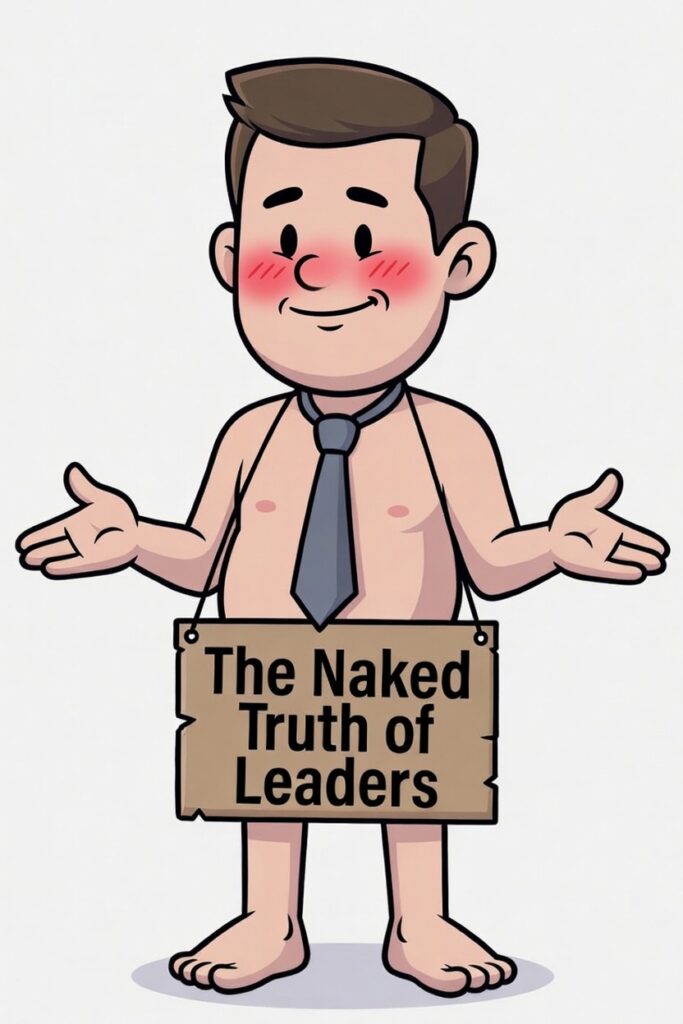
Once upon a time, in a kingdom that looked a lot like a Fortune 500 company, the Great Leader loved being worshiped by his subservient and dependent followers more than anything. Not the messy and frustrating work of influencing and collaborating with mere employees to get things done and make real changes. He ruled using the more expedient path of leading by executive decree. He loved the idea of being the Great Leader—the singular figure at the top, the visionary, the commanding, decisive one, the person whose presence supposedly made the enterprise go. He said jump, and the chorus of followers sang, “How High?”
One day, two skilled weavers with MBA’s covered in ivy arrived. They were consultants, authors, and program designers of the highest reputation throughout the business lands. They claimed they could weave the finest leader garment ever made that would proclaim the status of the Great Leader whenever he entered a room. This was no power suit from Gucci. The fabric was unrecognizable to the point of appearing invisible to anyone unfit for high office, anyone lacking the right competencies, anyone who simply did not “get” that Great Leaders do great leadership. Only the wise and well-versed business leaders who have been indoctrinated in the mythical wisdom leadership traditions such as situational, servant, transformational, empathetic, and resonant leadership-ready could see it in all of its regal status-draped glory.
The Great Leader, of course, saw nothing. Neither did his senior team. Neither did the board. Yet, everyone chose to remain silent. Admitting you could not see the clothes would mark you to be placed in the 9th box as unfit—not strategic, not executive material, not someone who understood what real leadership looked like. So they all praised the cut, the color, the way the fabric moved with authority. HR commissioned more of the same. Training budgets expanded. Books about the habits, traits, and mindsets of great leaders flew off the shelves. The procession began. The weavers gladly cashed their checks and quietly left the kingdom.
The organization marched forward, naked, unable to change. They were soon acquired by a highly collaborative giant company, whose executives embraced the meaningful differences in roles between executives, managers, leaders, and most importantly, collaborators. The once-great leader now greets you in their golf attire as a volunteer marshal at their country club golf course.
That is the modern retelling of the old fable, and it is the daily reality of leader-centrism. Leader-centrism is the human tendency to want to place our faith and hopes in the wisdom, knowledge, expertise, and protection of mythical Great Leaders so we feel protected from the mean and uncertain realities of the rapidly changing business operating environment. Leader-centrism is a failed philosophy that Leo Tolstoy warned against in his masterwork, “War and Peace.” Elevating the status and exaggerating the organizational value of the leader’s role creates an unhealthy co-dependency between status- and power-seeking would-be leaders and safety and responsiblity/accountability-avoidant followers.
The Industrial Illusion We Still Wear
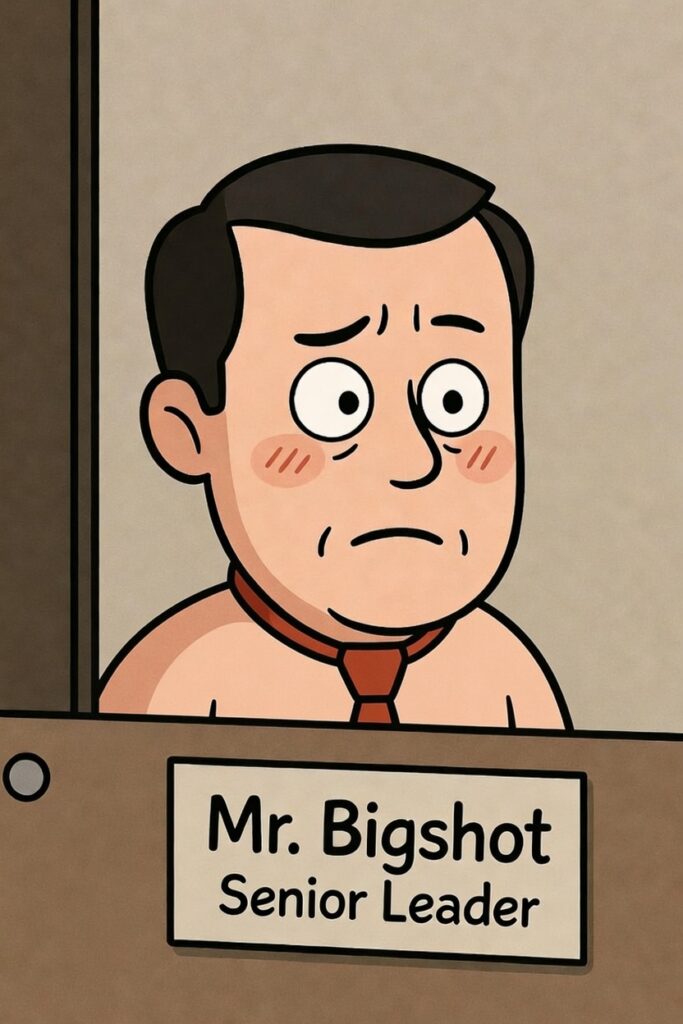
Matthew Chodkowski, EdD, Founding Director of the Institute for Postindustrial Leadership, has spent decades naming this organizational nakedness. Drawing on Joseph C. Rost, PhD, and others, Chodkowski argues that the dominant understanding of leadership remains trapped in an industrial-era paradigm: hierarchical, managerial, and relentlessly leader-centric. In that view, leadership and the leader are treated as synonyms. Leadership is whatever leaders do. This mythical hero-worship of the role of a leader, personified in an individual, prompts the futile cycle of developing better leaders—more authentic, more emotional, more servant-like, more level-5—and the organization will somehow become better at leadership and solve all of its issues.
Reality doesn’t work that way. The mythical archetypical hero great leader everyone projects their hopes and dreams upon never seems to show up to work.
Postindustrial leadership is not what a single leader does to followers. Chodkowski defines leadership as “an interactive influence relationship among collaborators who intend and enact real significant changes that reflect their mutual purposes.” Notice what is missing from that definition: the word leader. Modern leadership is leader-less, meaning the role of leader is not included in the leadership process. The gravitational pull of the old paradigm is so strong that even most progressive frameworks still orbit the individual leader. They simply dress the same mythical Great Leader in softer but still imaginary fabrics.
The result is predictable. Organizations become dependent on the next heroic figure. Organizational cults of personality form on the mythical Great Leader’s impact. Complex adaptive challenges—the kind that have no single right answer and require continuous collective sense-making—are handed to the person with the corner office as if authority equals capacity. People wait to be told what to do. Initiative slows. Collective intelligence and group experience stay unused. And when results disappoint, we diagnose a “leadership crisis” and call in new weavers of the next brand of the invisible cloth.
Senior executives feel this. You sense the gap between the language of empowerment and the reality of who still gets to define reality. You watch high-potential programs produce polished individuals who still struggle to create the conditions for real change with others. You see the cost in agility, in talent retention, and in the quiet exhaustion of people who know the emperor is naked but cannot say so without risking their standing. The complex organization demands a collaborative hierarchy that threatens the hard-won status of leaders. Many leaders believe if they cannot lead, they lose. My way or the highway can present itself dressed up in many fashionable “leadership” approaches. None of which actually lead to rapid adoption of change in a complex and ambiguous operating environment.
What the Child Sees
In Andersen’s tale “The Emperor’s New Clothes,” it takes a child to state the obvious: the Emperor has bought into the clever weavers’ lie. In organizational life, the “child” is the postindustrial paradigm itself: leadership lives in the relationship, not the role. Collaborators—people who bind themselves to mutual purposes and exert influence in both directions—do the actual work of leadership to significantly change organizations. The person holding formal authority may or may not be participating in the leadership practice at any given moment and may be evaluating and administering outside of the collaborative group.
This is not a call to abolish hierarchy or accountability. Management remains essential for governance and administration to evaluate the recommendations of the collaborative leadership group. Authority has its rightful place. But confusing management with leadership, or leading, and then locating all leadership inside the individual leader, leaves the organization nakedly exposed to dysfunction precisely when the environment demands adaptation and agility.
Chodkowski’s work is useful here because it refuses to tinker around the edges. Simply elevating “followers,” adding more soft skills to the leader’s toolkit, or inventing another model of the ideal leader does not escape the now obsolete industrial leadership paradigm. The shift required is deeper: from person to process, from individual to relationship, from control to mutual influence oriented toward real change. The shift requires an individual to internalize several scientifically valid organizational principles and then to integrate them into group dialog. If enough people learn these principles and become skilled collaborators, then the organization can institutionalize the Postindustrial Leadership Paradigm as the way it naturally approaches adopting significant organizational changes. See my post “How Complex Organizations Change” for an example of Postindustrial Leadership in action.
Practical Implications for Those Who Actually Run Things
If you sit in a senior role, the practical questions are straightforward:
• Where are we still waiting for a leader to appear or improve before the organization can move on with the hard adaptive work to change ahead of the market demands?
• How much of our leadership development budget still assumes that better leaders will automatically produce better leadership?
• When was the last time we treated the quality of the influence relationships across the system as the primary variable, rather than the traits of the people in positional power?
• Can we learn to trust our people with the most expertise, experience, and exposure to a proposed change to collaborate and find our best solutions?
• What would it look like to develop collaborators who can rally around mutual purposes instead of developing more people who aspire to be the recognized leader?
The organizations that will navigate the next decade of volatility are not the ones with the most impressive individual leaders. Future-proof organizations are the ones that have built the cultural capacity for leadership as collaboration in action. That capacity does not appear by accident. It requires deliberate unlearning of the industrial story we have all been sold. An excellent first step is to bring in the LEAD Program from the Institute for Postindustrial Leadership to learn the organizational principles where people can find the most leverage and influence to make lasting changes.
Beware: The leader-centric weavers are still very good at their dysfunctional craft. The How to Be A Great Leader books keep coming. The programs remain well-attended. A new flavor-of-the-month leadership program is no doubt being woven as we speak. All of them are based on the failed leader-centric mindset that leaves organizations exposed to the naked truth that modern leadership is leader-less.
The only question left is whether senior executives will keep applauding the invisible suit—or whether enough of us are willing to say, clearly and without career-ending theatrics, that the Great Leader has no clothes, is never showing up to work to save us, and that we have to collaborate to survive and thrive in today’s volatile workspace.
Leadership was never the leader. It is unfortunate that the word leadership contains the letters that also spell the word leader. We apply the same logic that leaders do leadership; we will expect to see cars doing carpentry. Leadership has always been a relationship. The sooner we stop pretending otherwise, the sooner we can stop marching naked and get to work building future-proof organizations together.
